
Reviewed for accuracy against veterinary, aquatic-science, and animal-welfare sources. See citations throughout and the reference list at the end.
Setting up your first aquarium can get expensive quickly — not because fish themselves are necessarily expensive, but because beginners are often encouraged to buy equipment they don't actually need.
The goal isn't to build the cheapest aquarium possible. It's to build the least expensive aquarium that can still provide a safe, stable, and appropriate environment for your fish.
That means spending money on the things that directly affect fish health and water quality, while avoiding unnecessary gadgets, expensive decorations, and equipment your particular aquarium doesn't require.
In this guide, we'll break down where your money matters most, where you can save, how to avoid buying the same equipment twice, and the safety steps that are easy to skip but shouldn't be.
1. Choose the Right Tank Size
One of the best ways to avoid wasting money is to choose the right aquarium before buying any fish.
A larger aquarium isn't automatically better for every species, but additional water volume generally provides greater stability than a very small aquarium. Small aquariums can experience faster changes in water quality, temperature, and waste concentration, which can make them less forgiving for beginners.
For many beginners, a 20-gallon freshwater aquarium can be a practical starting point because it provides useful swimming space while remaining manageable to maintain. This is a general guideline, not a rule — the right size ultimately depends on the species you intend to keep.
Consider:
- The adult size of the fish
- Their swimming requirements
- Whether they need to be kept in groups
- Compatibility with other species
- Their temperature requirements
- Their preferred water chemistry
- The available space in your home
- The weight the stand and floor can safely support
Before buying anything, read our guide on How to Choose the Right Aquarium for Your Fish to match your aquarium to the species you actually intend to keep.
Don't buy a tank based on juvenile size
A common beginner mistake is buying an aquarium based on how large the fish are when they're sold. Research the adult size and long-term requirements of each species first. Choosing an appropriately sized aquarium from the beginning can prevent the expense and disruption of upgrading later.
2. Spend Wisely on Filtration
Your aquarium filter is one of the most important pieces of equipment you will buy.
A good filter provides mechanical filtration to remove suspended particles and, more importantly, provides a surface where beneficial nitrifying microorganisms can establish biological filtration. These microorganisms process the ammonia and nitrite produced by fish waste and decomposing organic matter.
There isn't one filter type that's best for every aquarium. Common options include:
- Hang-on-back filters
- Sponge filters
- Internal filters
- Canister filters
For many beginner community aquariums, a hang-on-back filter can be a convenient choice because it is relatively simple to install and maintain. Sponge filters can also be excellent in appropriate setups, particularly where gentle water movement is desirable, although they require an air pump and airline equipment.
Choose a filter appropriate for the aquarium and its expected biological load rather than relying on a universal rule that every aquarium needs a particular multiple of its tank volume in turnover. Compare capacity, flow, media options, and replacement costs before buying.
For a detailed explanation, see How to Choose the Right Aquarium Filter.
Don't automatically buy replacement cartridges
Some filters use proprietary cartridges that need regular replacement; others allow you to maintain reusable sponge or biological media. Look at the long-term cost, not just the price on the box. A slightly more expensive filter may be cheaper to operate if you don't have to continually buy proprietary replacement media.
3. Cycling: The Step You Shouldn't Skip
A new aquarium does not automatically contain enough beneficial nitrifying microorganisms to process fish waste. During the nitrogen cycle, these bacteria and archaea convert ammonia into nitrite and then into nitrate — a two-step process carried out by distinct groups of microorganisms.
Target values before adding fish: ammonia and nitrite should both test at essentially 0 ppm, consistently, for several days in a row, before fish are introduced. Nitrate will be present and is far less toxic, but should also be kept in a reasonable range through regular water changes once the tank is stocked.
That's why you should establish the biological filter before adding a full stock of fish.
Fishless cycling is the safer beginner approach
A fishless cycle lets you establish the biological filter without exposing live fish to dangerous ammonia and nitrite levels. A general fishless-cycling process involves:
- Setting up the aquarium and starting the filter.
- Adding an appropriate ammonia source according to the cycling method being used.
- Testing ammonia and nitrite regularly.
- Allowing the biological filter to develop.
- Continuing until testing shows the aquarium can process the intended ammonia load, with ammonia and nitrite reading 0 ppm within 24 hours of dosing.
- Performing an appropriate water change before introducing fish.
- Adding fish gradually rather than immediately stocking the aquarium to its maximum.
Don't rely on a fixed number of days. Cycling time varies significantly between aquariums — one study monitoring home aquariums found ammonia and nitrite dropped to undetectable levels by week 3 in some tanks but not until week 8 in another — so water testing is more useful than waiting for an arbitrary number of weeks.
For more beginner mistakes to avoid, read 20 Freshwater Aquarium Mistakes Every Beginner Should Avoid.
Bottled bacteria isn't a magic shortcut
Some commercial bacterial products may help establish biological filtration, but they should not replace testing. Overdosing certain ammonia-neutralizing or "start-up" products can actually inhibit nitrifying bacteria and delay cycling, so follow label directions carefully rather than assuming more is better. The safest approach is to verify the aquarium's water chemistry with a test kit before adding fish.
4. Treat Your Tap Water Properly
Tap water often contains disinfectants such as chlorine or chloramine. These make water safe to drink, but they are toxic to fish — and to the beneficial bacteria in your filter — even at very low concentrations (chlorine and chloramine are harmful to fish in quantities as small as 0.05 ppm).
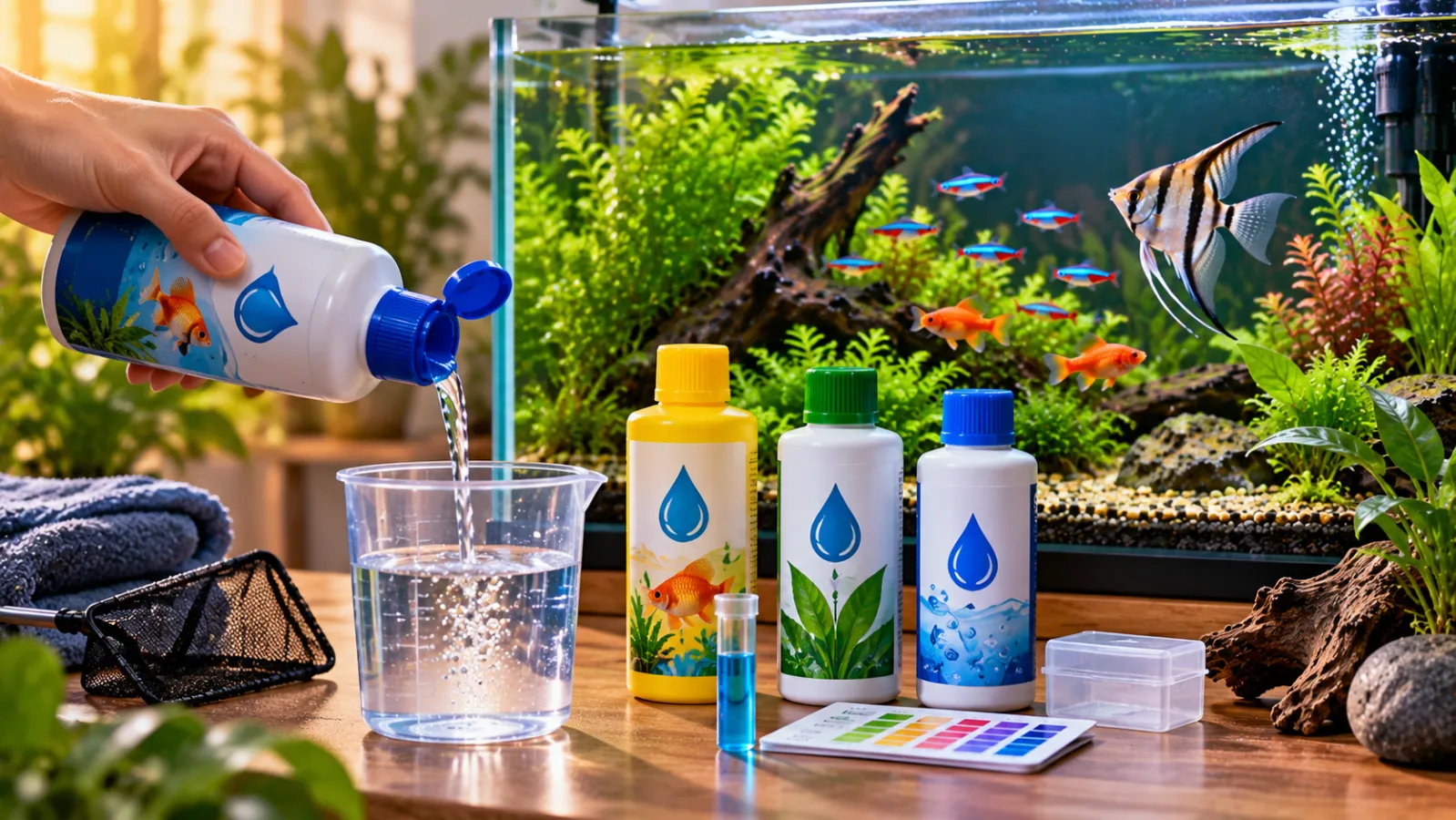
If your water supply contains chlorine or chloramine, use an appropriate aquarium water conditioner according to the manufacturer's instructions every time you add tap water, not just at initial setup. Don't assume that water safe for people to drink is ready to add directly to an aquarium.
Note that chloramine is chlorine chemically bonded to ammonia. A conditioner that only neutralizes chlorine can leave the ammonia portion behind, so check that your product is specifically labeled to handle chloramine, not just chlorine.[^4]
Your local water supply may also have characteristics such as:
- pH
- General hardness (GH)
- Carbonate hardness (KH)
These can matter depending on the fish and other organisms you keep.
For help choosing an appropriate product, read How to Choose the Right Water Conditioner for Your Aquarium.
Don't automatically buy specialty water products
Most beginners don't need a cabinet full of different water treatments. Start by understanding your water source and your fish's requirements. If you're using well water, reverse-osmosis water, or another non-standard source, test it first and determine what treatment, if any, is actually necessary.
5. Buy a Reliable Heater If Your Fish Need One
Not every aquarium requires a heater — some species (such as goldfish or White Cloud Mountain minnows) are suited to cooler water, while tropical species generally require a controlled temperature range.
If your fish require heating, choose a reliable thermostat-controlled heater and use a separate thermometer to monitor actual tank temperature (don't rely on the heater's dial alone).
Heater safety: never plug in a heater unless it is fully submerged to the manufacturer's recommended level — running one partially exposed to air can cause it to overheat, crack, or shatter. Use a grounded, ideally GFCI-protected outlet near water, and unplug the heater before doing a water change that would expose it to air.
There isn't a universal wattage that's perfect for every aquarium. The appropriate heater depends on:
- Aquarium volume
- Room temperature
- Desired aquarium temperature
- Room location
- Temperature difference the heater needs to overcome
Avoid buying a heater purely because it has the highest wattage or the lowest price.
For more information, see How to Choose the Best Aquarium Heater.
6. Don't Skip Water Testing
A water-test kit is one of the most useful purchases a beginner can make. Clear water doesn't necessarily mean the water is safe — ammonia and nitrite are invisible.
For a typical freshwater aquarium, useful tests include:
- Ammonia (target: 0 ppm in a cycled, stocked tank)
- Nitrite (target: 0 ppm)
- Nitrate (keep in a reasonable range via water changes; exact targets vary by species)
- pH
Depending on your species and water source, testing GH and KH may also be useful.
Testing is particularly important during cycling and whenever something changes, such as adding fish, a filter failure, or unusual fish behavior.
For a beginner-friendly explanation of what the numbers mean, read How to Test Aquarium Water: A Beginner's Guide.
Don't buy every test kit available
You don't need every test sold in a fish store. Start with the parameters relevant to your aquarium and fish, and add tests when your species, water source, or a specific problem makes them useful.
7. Save Money on Substrate
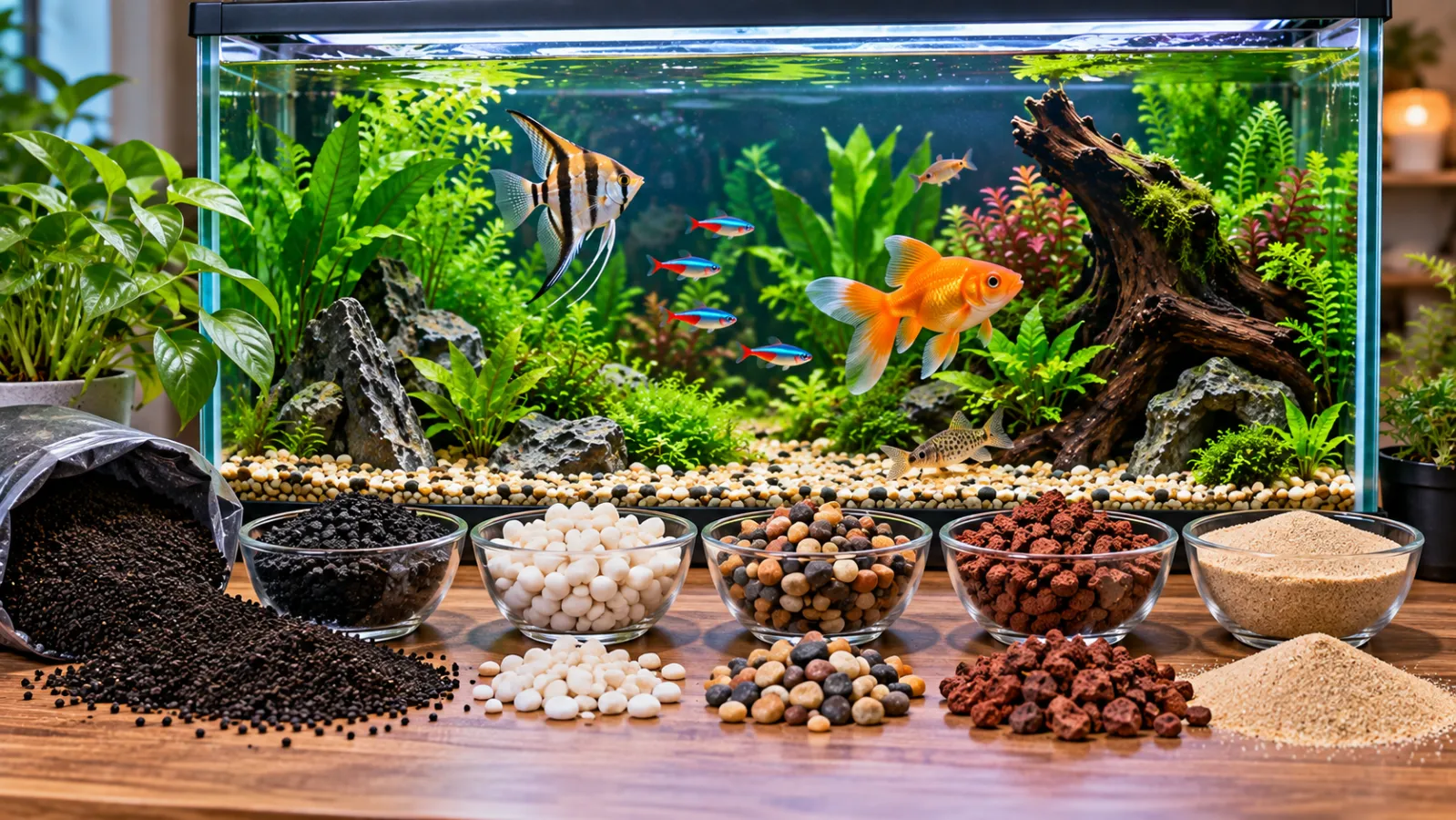
You don't need the most expensive substrate to create a good aquarium. For many beginner freshwater setups, ordinary aquarium gravel works well. Your choice should depend on what you're keeping — planted aquariums may benefit from different substrate, and certain bottom-dwelling fish have specific substrate preferences.
Before buying, see Best Aquarium Gravel and Substrate: What Should You Choose?
Choose a substrate that is appropriate for your fish, aquarium-safe, suitable for your plants (if applicable), and practical to clean. You don't need to spend extra simply because a substrate is marketed as premium.
8. Keep Decorations Simple
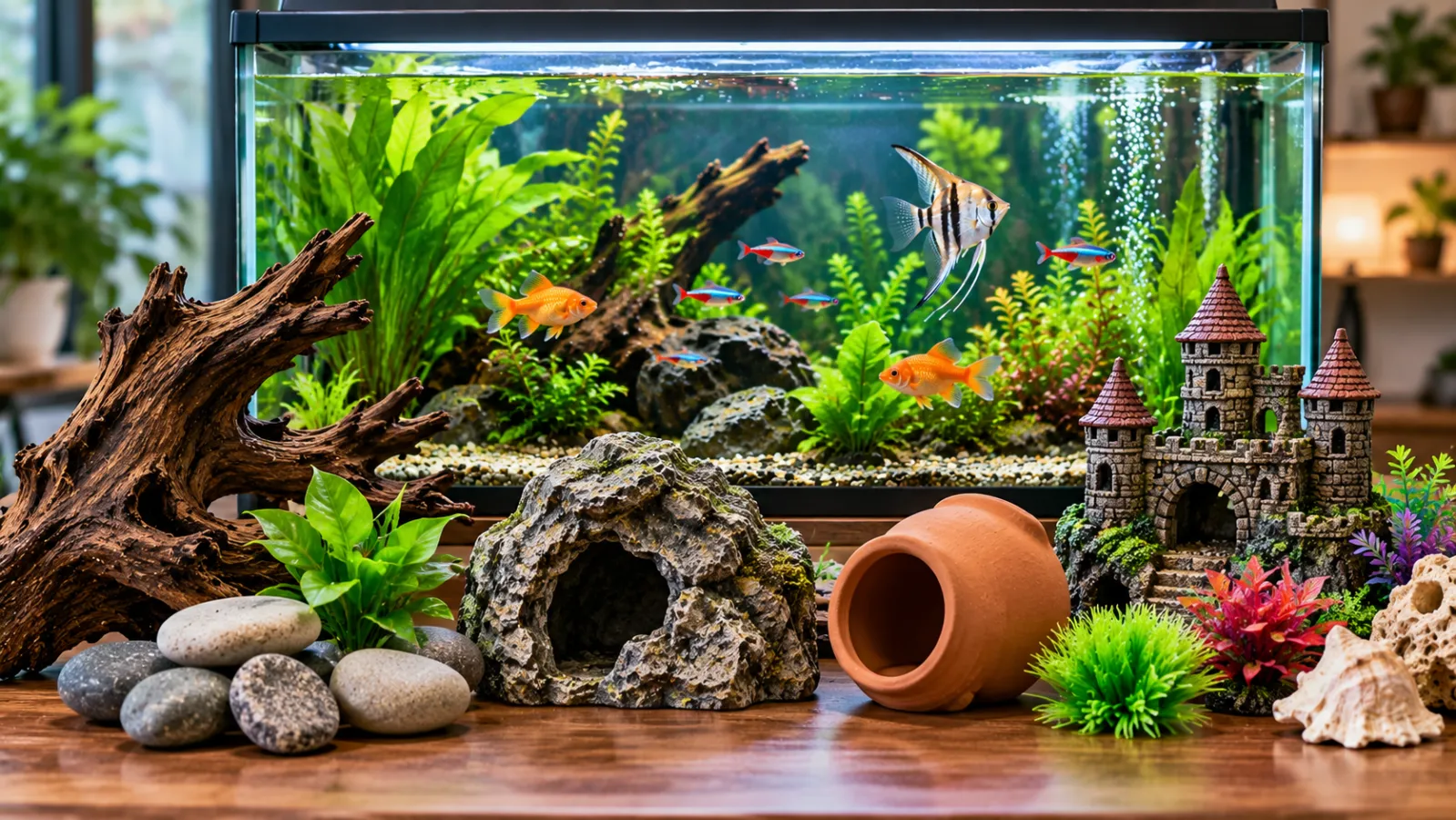
Decorations can make an aquarium look great without consuming a large portion of your budget. Depending on your fish, you can use aquarium-safe rocks, driftwood, live or artificial plants, caves, and simple ornaments.
Avoid decorations with sharp edges, unsafe materials, unstable structures, or coatings that could deteriorate in water. Some fish benefit from hiding places and environmental structure, so decorations shouldn't be chosen purely for appearance.
For more guidance, read How to Choose Safe Aquarium Decorations.
9. Buy the Basic Maintenance Equipment
A beginner can usually get by with:
- A fish net
- A dedicated aquarium bucket
- A gravel cleaner or siphon
- A basic thermometer
- Appropriate lighting
- Basic cleaning equipment
There's rarely a good reason to spend heavily on a premium version of a tool that does the same basic job as an inexpensive alternative.
For a complete overview, see Essential Aquarium Equipment Every Beginner Needs.
Keep one bucket exclusively for the aquarium
Never use a bucket that has held household cleaning products or other chemicals — even trace residue can be lethal to fish. A bucket dedicated to aquarium use is inexpensive insurance.
10. What Can You Skip?
You can often postpone or skip:
- CO₂ systems for basic non-planted aquariums
- Automatic dosing systems
- UV sterilizers
- Expensive decorative equipment
- Premium versions of simple maintenance tools
- Automatic feeders when you can feed the fish yourself
- Specialized testing equipment not relevant to your species or water source
These products aren't bad — some are genuinely useful in the right setup. The point is: don't buy equipment because it exists — buy it because your aquarium needs it.
11. Acclimating and Quarantining New Fish
This step is easy to skip and easy to get wrong, and it's one of the most common causes of preventable fish loss and disease outbreaks.
Acclimation
Fish transported from a store are in water that differs from your tank in temperature, pH, and other chemistry. Introducing them too quickly can cause lethal shock. A basic approach:
- Turn off the aquarium lights to reduce stress.
- Float the sealed bag in the tank for about 15–20 minutes to equalize temperature.
- Gradually mix small amounts of tank water into the bag over 20–30 minutes (the "drip" or "add-a-little" method) to let the fish adjust to your water chemistry.
- Net the fish into the tank and discard the bag water rather than pouring it into the aquarium, since it may carry pathogens or waste products from the store's system.
Quarantine
Where practical, new fish should be held in a separate quarantine tank for a period (commonly several weeks) before being added to an established aquarium. This isolates parasites or diseases that aren't yet visibly obvious, protecting your existing fish. A basic quarantine setup doesn't need to be elaborate — a small cycled tank with a sponge filter and heater is often enough. This step is optional for a strict beginner budget but is a genuine welfare and financial safeguard, since treating an outbreak in a fully stocked display tank is far more expensive and stressful than treating one fish in isolation.
12. Don't Forget Basic Aquarium Maintenance
The initial setup isn't the only cost to consider. A healthy aquarium requires regular maintenance.
Daily
- Check that the fish are behaving normally.
- Check the aquarium temperature.
- Make sure the filter is running.
- Feed an appropriate amount of food.
Regularly
- Test water according to the aquarium's stage and needs.
- Remove obvious waste and debris.
- Inspect equipment.
- Perform partial water changes as appropriate.
- Clean equipment safely when required.
For a practical routine, see How to Build an Easy Aquarium Maintenance Routine, and for water changes specifically, How to Perform a Safe Aquarium Water Change.
Don't over-clean the aquarium
An aquarium isn't supposed to be sterile. Beneficial nitrifying bacteria live on surfaces throughout the tank, particularly in the filter media. When cleaning biological filter media, avoid exposing it to untreated chlorinated tap water, since chlorine and chloramine are toxic to these bacteria at very low concentrations.Rinsing filter media in removed aquarium water (during a water change) instead helps preserve the established biological community.
13. Stock Slowly
Even if your aquarium looks empty, resist the temptation to fill it immediately. The number of fish an aquarium can safely support depends on far more than gallons of water. Consider adult fish size, swimming requirements, social behavior, compatibility, waste production, filtration, water chemistry, and your maintenance capacity.
Research each species before purchasing it, then introduce fish gradually — using the acclimation steps above — and continue monitoring water quality. This is better for the fish and can also save money by reducing the chance of water-quality crashes, emergency equipment purchases, or fish loss.
14. Where Should Your Aquarium Budget Go?
Spend carefully on:
- An appropriately sized aquarium
- Reliable filtration
- Appropriate heating when required
- A thermometer
- Water-testing equipment
- Appropriate water conditioner
- Safe maintenance equipment
Save money on:
- Basic substrate
- Simple nets
- Dedicated buckets
- Basic siphons
- Simple decorations
- Non-essential gadgets
- Premium versions of basic tools
Save money on convenience and decoration — not on fish welfare or water quality.
15. A Practical Beginner Budget
Prices vary considerably depending on where you live, brand, whether equipment is new or used, and whether the aquarium comes as a kit. The figures below are a rough US-market planning framework, not fixed prices.
| Item Approximate Budget Priority | ||
| Aquarium + suitable stand | $80–150+ | Essential |
| Filter | $20–60+ | Essential |
| Heater (if required) | $15–40+ | Essential for tropical setups |
| Thermometer | $3–10 | Essential |
| Water-test kit | $20–30+ | Essential |
| Water conditioner | $8–15+ | Essential when treating tap water |
| Substrate | $10–25+ | Setup-dependent |
| Net + bucket + siphon | $15–30+ | Essential |
| Fish food | $5–15+ | Essential |
| Plants/decorations | Variable | Optional / setup-dependent |
The biggest money-saving opportunity is often avoiding unnecessary purchases rather than finding the absolute cheapest version of every item.
16. Budget for the Aquarium After Setup
Expenses don't stop when the fish go in. Plan for:
- Fish food
- Water conditioner
- Electricity
- Test reagents
- Filter media, when replacement is actually necessary
- Plant supplies, if applicable
- Replacement equipment
- Unexpected fish-care expenses
Your actual monthly cost depends heavily on your equipment, stocking level, local electricity prices, and maintenance routine. A reliable setup that's appropriately stocked and properly maintained can be more economical long-term than a poorly planned aquarium that constantly needs emergency fixes.
Beginner Aquarium Checklist
Before adding fish, make sure you have:
- Aquarium appropriately sized for the adult fish
- Safe, sturdy support
- Suitable filter
- Heater if required (fully submersible, thermostat-controlled)
- Thermometer
- Water-testing kit
- Appropriate water conditioner (rated for both chlorine and chloramine, if applicable)
- Suitable substrate
- Aquarium-safe decorations or plants
- Fish net
- Dedicated bucket
- Siphon/gravel cleaner
- Appropriate fish food
- A fishless cycling plan
- A stocking plan based on adult fish size and compatibility
- A basic maintenance routine
- A plan for acclimating (and ideally quarantining) new fish
- A budget for ongoing care
Most importantly:
- Ammonia and nitrite both test at 0 ppm before fish go in
- The aquarium's biological filtration is established
- You know the temperature requirements of your fish
- You understand the basic water-chemistry requirements of your species
- You are prepared to maintain the aquarium — and acclimate new fish — properly
Final Takeaway
Building a beginner-friendly aquarium on a budget doesn't mean buying the cheapest equipment available. It means spending deliberately.
Put your money into what genuinely affects your fish: appropriate tank size, filtration, water quality, testing, suitable temperature control, safe equipment, careful acclimation, and responsible stocking. Save money on unnecessary gadgets, excessive decoration, and premium versions of basic tools.
Most importantly, don't rush the process. A properly prepared and maintained aquarium — where fish are cycled in safely, tested regularly, and introduced carefully — is a much better investment than an expensive aquarium full of equipment you don't actually need.
The best budget aquarium isn't the one with the smallest receipt. It's the one that provides your fish with a safe, stable environment without making you pay for unnecessary equipment.
References
Nitrification in home aquarium biofilters — home aquarium study documenting the ammonia → nitrite → nitrate process and the microorganisms responsible: NCBI — Microbial community succession of home aquarium biofilters: Same source — cycling timeline varied from 3 to 8 weeks across three monitored home aquariums, supporting testing over fixed timelines: NCBI — Microbial community succession of home aquarium biofilters : Overdosing ammonia-removing/start-up products can inhibit nitrifying bacteria and delay cycling: Dr. Tim's Aquatics — Tap Water Detoxifier : Chlorine and chloramine toxicity to fish and nitrifying bacteria at low concentrations, and the chlorine/ammonia composition of chloramine: Fritz Aquatics — About Chloramine; Aquarium Science — Chlorine and Chloramine
General care and setup guidance:
- RSPCA — Fish and Aquariums
- Ornamental Aquatic Trade Association (OATA) — How to Set Up and Look After a Freshwater Tank/Aquarium
- OATA — How to Test Water Quality in Your Freshwater Tank/Aquarium
- Aqueon — Aquarium Filtration Basics
- Aqueon — How to Choose the Best Filter for You and Your Tank
How we create our content: Our articles are developed using AI-assisted research, cross-checked with multiple AI systems, and validated against reputable professional and authoritative sources before publication.